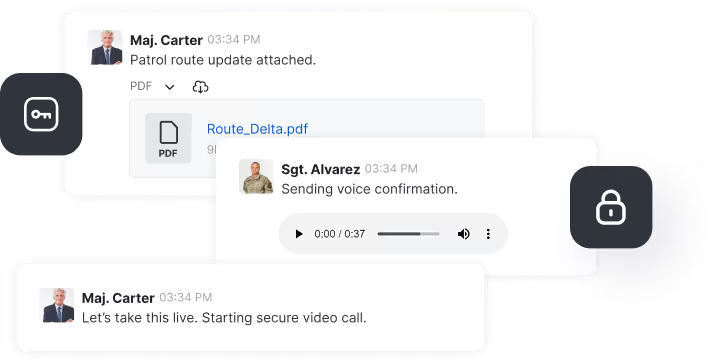
Trafikverket, the Swedish Transport Administration went live with federation on Rocket.Chat, chatting directly with Försäkringskassan, the Swedish Social Insurance Agency, which runs another Matrix-based platform. Neither agency moved to a shared platform or routed messages through a third-party bridge. Each kept its own deployment, its own admin console, and its own security posture, and users on either side can now open a conversation with the other agency as if they were on the same system.
That's what federation means in practice: two independently operated chat platforms speaking the same protocol, so a message sent from one reaches a user on the other without either side handing over control of its own infrastructure. No migration, no shared tenant.
The report behind the pilot
This pilot is the practical follow-through on a direction eSam set out in its January 2026 report on chat federation for the public sector. Its core argument: Swedish authorities shouldn't have to agree on one chat vendor to collaborate with each other. Each agency should be free to choose the platform that fits its own operational, legal, and security needs, while still being able to reach every other agency directly.
That framing sits squarely inside digital sovereignty: control over where data lives, who can access it, which laws govern it, and whether an agency's ability to communicate depends on one commercial provider's roadmap. Federation is how eSam proposed to reconcile freedom of choice with the need to stay connected, rather than forcing a choice between fragmentation and lock-in.
Part of a wider European shift
Sweden isn't acting alone. The EU's Interoperable Europe Act, Regulation (EU) 2024/903, already pushes member states toward interoperable public services rather than isolated national systems, and NIS2 layers security and resilience requirements on top. Across Europe, digital sovereignty has moved from a compliance checkbox to a governing principle for public sector IT, and federated communication keeps surfacing as one of its most concrete expressions, precisely because it avoids the vendor lock-in that a single shared platform would create.
Agencies and ministries in several EU countries are making the same calculation: sovereignty doesn't mean everyone running identical software, it means everyone controlling their own systems while still being able to open a direct line to anyone else who needs one. The Trafikverket-Försäkringskassan link is a specific instance of a shift already underway well beyond Sweden's borders.
Modernizing without the tradeoff
Alongside the policy pressure, a more immediate push is nudging agencies the same way. Agencies across the public sector are moving off end-of-support tools like Skype for Business, and most don't want the only modern alternative to be a large foreign-owned cloud suite they don't control. That reluctance shows up in the numbers: eSam's own survey found that only one of its 41 member agencies had gone all-in on a US public cloud service as its sole communications platform. The rest took a more cautious route, largely because of legal uncertainty, security concerns, and the need to stay in control of their own data.
Federation is built to remove that tradeoff. An agency doesn't have to choose between staying on an unsupported tool and handing its communications to a platform it doesn't control just to stay reachable. It can modernize onto something it operates and governs itself, and still reach agencies that modernize differently. Trafikverket didn't need Försäkringskassan to adopt Rocket.Chat, and Försäkringskassan didn't need to give up their platform, because both speak the same federated protocol underneath.
That reach isn't limited to organizations already on Matrix. Much of government and defense messaging still runs on XMPP, the protocol NATO's Federated Mission Networking has relied on for two decades because it can be self-hosted, audited, and air-gapped. Rocket.Chat's 8.7 release added a bridge so those systems can join the same federated conversations without switching platforms either. The upshot is one modernization decision, not two: leave the end-of-support tool behind, keep data and infrastructure under your own control, and stay reachable no matter what the agency on the other end is running.
.avif)
Frequently asked questions about <anything>


- Digital sovereignty
- Federation capabilities
- Scalable and white-labeled

- Highly scalable and secure
- Full patient conversation history
- HIPAA-ready

for mission-critical operations
- On-premise and air-gapped ready
- Full control over sensitive data
- Secure cross-agency collaboration
%201.svg)
- Open source code
- Highly secure and scalable
- Unmatched flexibility

- End-to-end encryption
- Cloud or on-prem deployment
- Supports compliance with HIPAA, GDPR, FINRA, and more

- Supports compliance with HIPAA, GDPR, FINRA, and more
- Highly secure and flexible
- On-prem or cloud deployment