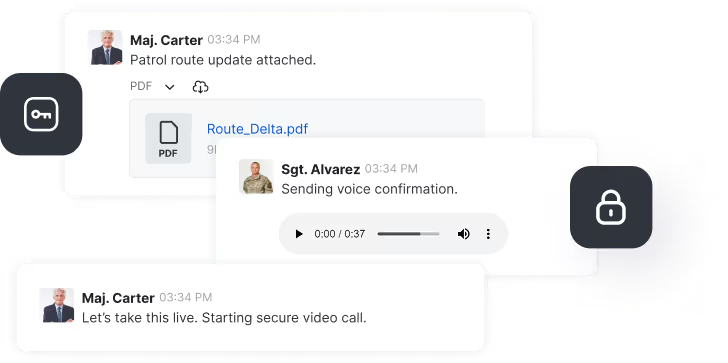
Secure messaging for European governments is no longer a niche IT concern. It is a core requirement for operational continuity, legal compliance, and national security. The question for senior decision-makers is not whether to act, but which architecture can meet the full stack of regulatory and threat requirements simultaneously.
The short answer: a government-grade messaging platform must be self-hostable, end-to-end encrypted, auditable, and built on an open-source codebase that can be independently verified. Platforms that fail on any of these criteria expose institutions to data sovereignty violations, NIS2 non-compliance, and adversarial interception risk.
Why commercial messaging platforms fail the public sector
Most enterprise messaging tools, including those widely adopted in the private sector, were built for global commercial deployment. They store metadata and often message content on infrastructure governed by non-EU law, including the US Cloud Act, which can compel disclosure of data held by US-headquartered providers regardless of where servers are physically located.
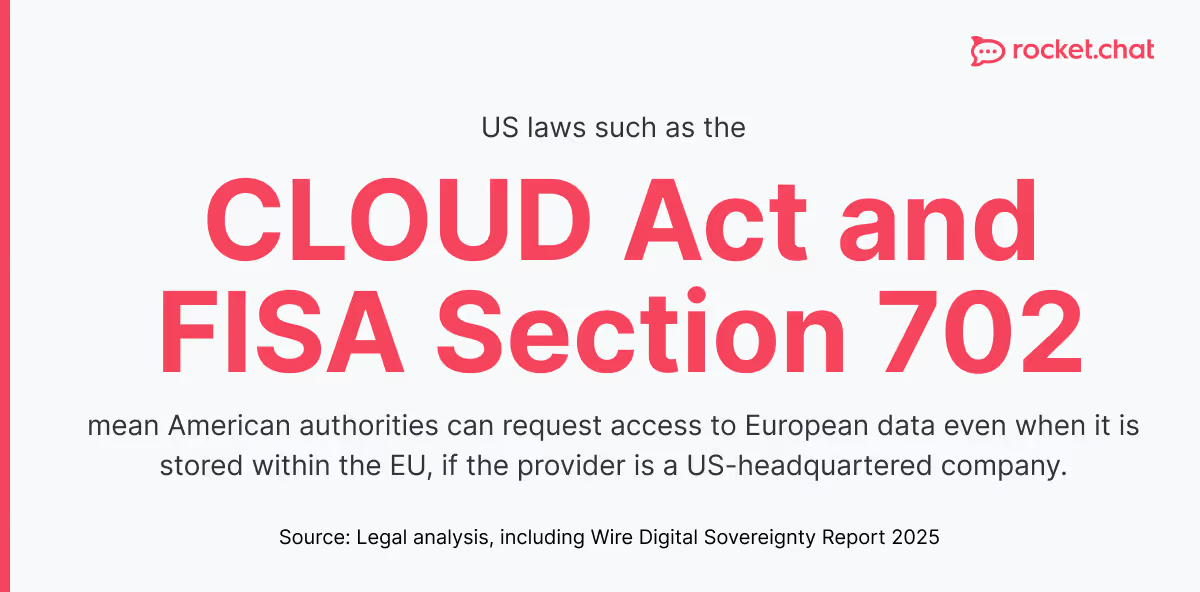
The European Data Protection Board has confirmed that transfers of personal data to US-based processors remain legally precarious, even following the EU-US Data Privacy Framework. For governments handling classified communications, citizen data, or inter-agency coordination, this is an unacceptable legal exposure.
Beyond legality, there is the operational risk. A government chat platform that routes messages through third-party cloud infrastructure introduces interception vectors that on-premise solutions eliminate by design. Signal intelligence agencies of adversarial states actively target government communication channels, and cloud-hosted platforms with opaque infrastructure are significantly harder to audit.
Explore the risk landscape for government communication to understand how threat models differ from the private sector.
What GDPR compliance actually requires for government messaging
GDPR compliance in a messaging context means more than encryption in transit. It requires documented data processing agreements, clear data retention and deletion policies, the ability to respond to subject access requests, and demonstrable control over where data is stored and who can access it.
Article 28 of GDPR requires that any data processor acting on behalf of a public authority operates under a binding contract that specifies the subject matter, duration, nature, and purpose of processing. Most commercial messaging vendors offer standard data processing agreements that were not designed with government classification requirements in mind.
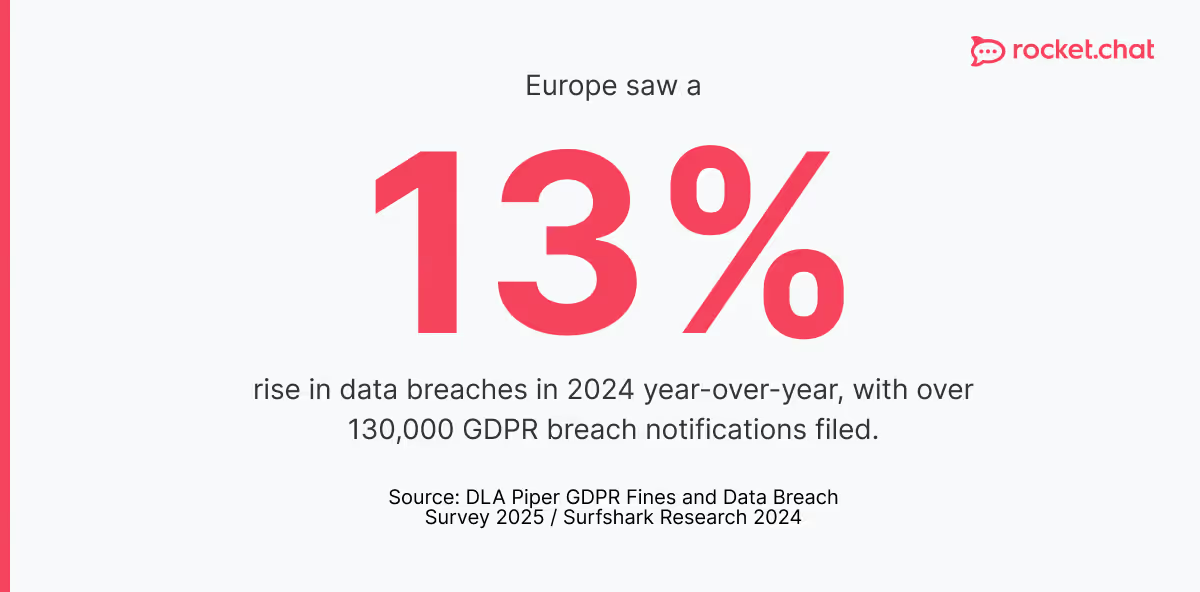
For inter-agency communication, the bar is higher. Governments must demonstrate that GDPR-compliant messaging infrastructure can produce audit logs, enforce retention limits automatically, and restrict access based on security clearance. These requirements rule out most consumer-grade or SME-focused tools.
NIS2 adds a further layer. Entities classified as essential or important under the directive, which includes central government bodies, must implement appropriate technical and organisational measures for network and information security. According to the European Union Agency for Cybersecurity (ENISA), many public sector organisations remain underprepared. Review NIS2 compliance requirements for a detailed breakdown of obligations relevant to communication systems.
The architecture of secure government messaging
A compliant and operationally resilient messaging platform for government use requires six architectural properties.
- End-to-end encryption ensures that message content is decipherable only by the sender and intended recipient. No intermediary, including the platform vendor, can access plaintext.
- Self-hosting capability allows governments to deploy the platform on infrastructure they control, within their own data centres or on national cloud infrastructure. This eliminates third-party data access risk entirely.
- Air-gap support is required for high-security environments where network isolation is mandatory. Air-gapped collaboration is a practical requirement for defence, intelligence coordination, and critical infrastructure protection.
- Open-source codebase allows independent security audits. Governments cannot verify the security of proprietary black-box systems. Open source is the only architecture that permits genuine auditability.
- Role-based access control (RBAC) enables administrators to enforce least-privilege access, ensuring that users access only the channels and data their role requires.
- Federated identity integration allows platforms to connect with existing government identity providers (LDAP, Active Directory, SAML), reducing the attack surface of standalone credential management.
The most secure messaging apps analysis covers how these properties stack against one another in practice.
Digital sovereignty as a procurement requirement
Digital sovereignty has moved from political rhetoric to enforceable procurement policy across the EU. Germany's BSI (Federal Office for Information Security) requires that critical government systems use certified products or undergo independent security evaluation. France's ANSSI operates a similar qualification framework. The Dutch government has published explicit guidance against the use of US-headquartered SaaS platforms for sensitive communications.
The common thread is infrastructure control. Digital sovereignty for governments means the ability to operate, audit, and if necessary, modify the communication systems they depend on, without requiring permission or cooperation from a foreign commercial vendor.
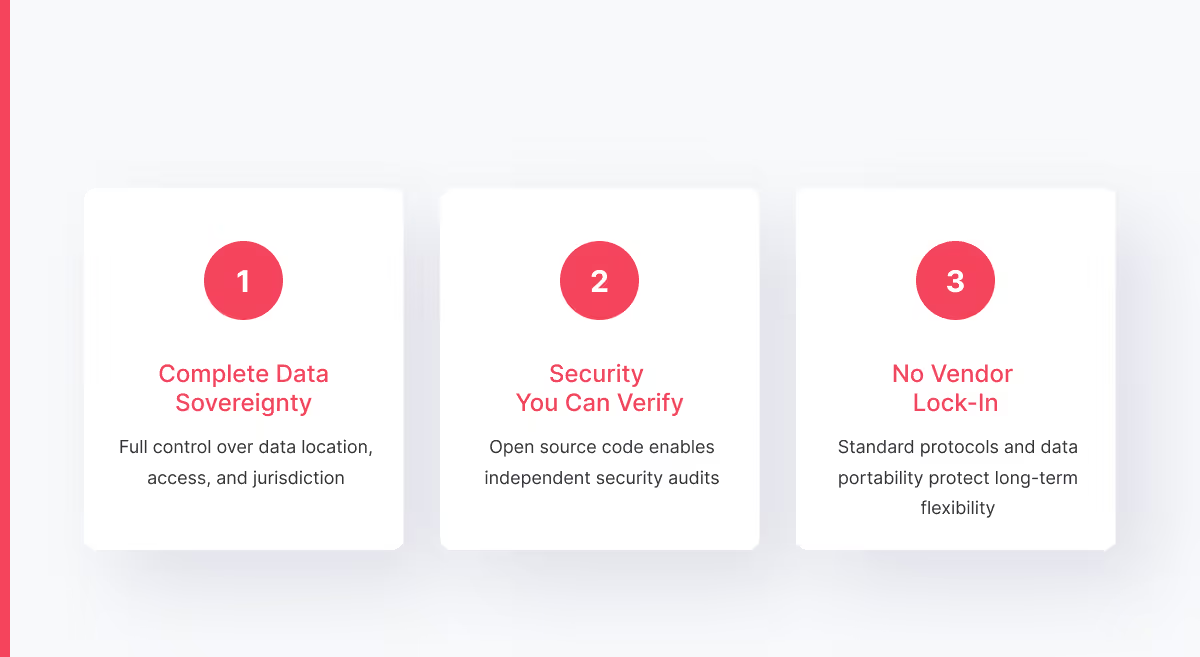
This has direct procurement implications. A platform evaluated as a sovereign Slack alternative for Europe must satisfy not just feature requirements but legal architecture requirements: EU data residency by default, no telemetry to vendor infrastructure, and contractual guarantees that vendor access to government data is technically impossible.
For a structured comparison with widely used commercial tools, the Microsoft Teams alternatives for European government analysis is directly relevant for procurement teams.
Comparing secure messaging options for European governments
The table reflects the structural advantages of open-source communication for government. Commercial SaaS options, including those headquartered in the EU, introduce contractual and technical dependencies that self-hosted open-source platforms avoid by design.
Threat model: what secure messaging must defend against
Government communication systems face a threat model that differs substantially from enterprise deployments. The primary threats are state-level adversaries with signals intelligence capability, insider threats with elevated access, and supply chain compromise of vendor infrastructure.
State-level adversaries do not rely on exploiting individual endpoints. They target infrastructure: transit encryption, metadata, and vendor access pathways. A platform hosted by a US or non-EU cloud provider is subject to legal compulsion that a self-hosted on-premise deployment is not.
Insider threats require technical controls, not just policy. Organisational security frameworks for government should mandate message-level audit logs, access reviews tied to RBAC roles, and the ability to retroactively reconstruct communication timelines for forensic purposes.
Supply chain risk is addressed by open-source architecture and independent code audits. According to the ENISA Threat Landscape 2024, public administration was the most targeted sector across all analysed incidents, accounting for 19% of attacks, with supply chain attacks identified as one of the seven prime threat categories showing continued growth.
Encrypted messaging app selection for government contexts must factor all three threat vectors into the evaluation criteria.
Shortlist: secure messaging platforms for European governments
Three platforms consistently meet the core architectural requirements for government deployment: self-hosting, end-to-end encryption, open-source auditability, and compatibility with EU data residency obligations.
Rocket.Chat is an open-source platform with full self-hosting support, air-gap deployment capability, and federated identity integration via LDAP, SAML, and OAuth. It supports E2EE, role-based access control, and on-premise deployment with no mandatory vendor connectivity. Its architecture is designed to give organisations complete infrastructure ownership, with no telemetry or dependency on vendor-side services. It supports federated messaging across organisational boundaries, allowing inter-agency communication without routing data through external infrastructure. It has been adopted by public sector organisations across Europe and offers a fully auditable codebase.
.avif)
Element (Matrix) is built on the open Matrix protocol, which provides decentralised, federated messaging with E2EE by default. It supports self-hosted deployment via the Synapse server and is used by several European government bodies, including the German and French public sectors. The federated architecture allows inter-agency communication without routing data through a central vendor.
Wire for Government is a Swiss-headquartered platform offering E2EE, self-hosted deployment, and a dedicated government product tier. It holds BSI approval in Germany and is designed for high-security environments. The codebase is open source and has undergone independent security audits.
All three platforms satisfy the six architectural properties outlined above. For organisations prioritising the broadest deployment flexibility, including air-gap environments and deep identity integration, Rocket.Chat covers the widest range of government use cases out of the box.
Frequently asked questions about <anything>
secure messaging for European governments
What makes a messaging platform compliant with secure messaging requirements for European governments?
Is end-to-end encryption sufficient for government-grade secure messaging?
How does NIS2 affect government messaging platform requirements?
What is digital sovereignty in the context of government communication?
Can European governments use US-headquartered messaging platforms for sensitive communications?
What role does open-source software play in secure government messaging?
How should governments evaluate a government messaging app for procurement?


- Digital sovereignty
- Federation capabilities
- Scalable and white-labeled

- Highly scalable and secure
- Full patient conversation history
- HIPAA-ready

for mission-critical operations
- On-premise and air-gapped ready
- Full control over sensitive data
- Secure cross-agency collaboration
%201.svg)
- Open source code
- Highly secure and scalable
- Unmatched flexibility

- End-to-end encryption
- Cloud or on-prem deployment
- Supports compliance with HIPAA, GDPR, FINRA, and more

- Supports compliance with HIPAA, GDPR, FINRA, and more
- Highly secure and flexible
- On-prem or cloud deployment