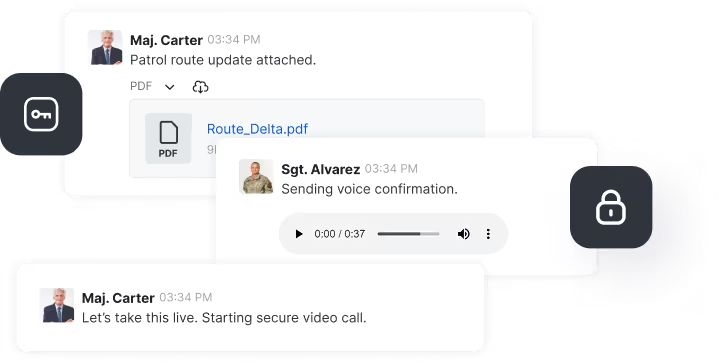
Organizations handling sensitive data face a straightforward problem: the tools they use for secure team chat were not designed for the environments they operate in. Commercial SaaS platforms store data on vendor-controlled infrastructure, route traffic through third-party servers, and offer limited visibility into how communications are processed, stored, and accessed. For government agencies, defense organizations, and critical infrastructure operators, that setup creates risk that no security policy can fully mitigate.
Secure internal communication is the practice of protecting organizational messaging, file sharing, voice, and video from unauthorized access, interception, and data leakage, while maintaining full auditability and compliance with applicable regulations. In regulated and high-assurance environments, this is no longer optional. The EU's NIS2 directive, which entered enforcement in 2024, explicitly requires encrypted internal communication and multi-factor authentication for entities classified as essential or important. Non-compliance carries fines of up to 10 million euros or 2% of global revenue for essential entities.
The shift is significant. Five years ago, secure internal communication was a concern for intelligence agencies and classified programs. Today, it applies to hospitals, energy providers, transport operators, and municipal governments. The question is no longer whether to secure internal communications, but how to do it without locking the organization into tools that create new dependencies and blind spots.
Why most collaboration tools fail in regulated environments
The core issue with mainstream collaboration platforms is architectural. Tools like Slack and Microsoft Teams were built for convenience and speed of adoption, not for environments where data residency, encryption key ownership, and formal accreditation are requirements.
- Data residency is the first problem. When a government ministry in Germany or a defense contractor in the UK uses a SaaS collaboration tool, their data typically traverses and resides in infrastructure controlled by a foreign vendor. Under GDPR and the Schrems II ruling, this creates legal exposure. Under national security frameworks, it may be outright prohibited.
- Encryption key control is the second. Most SaaS platforms encrypt data in transit and at rest, but the vendor holds the keys. The organization cannot independently verify what happens to its data, cannot perform its own cryptographic audits, and cannot guarantee that a foreign government order will not compel access. For organizations handling OFFICIAL-SENSITIVE, classified, or critical infrastructure data, this is a deal-breaker.
- Audit and compliance readiness is the third. Formal accreditation processes, whether ATO in the U.S., NCSC Secure by Design in the UK, or ISO 27001 globally, require the organization to demonstrate control over its communication security posture. Vendor-managed platforms make this difficult because the organization cannot fully inspect, configure, or govern the underlying system.
IBM's 2024 Cost of a Data Breach Report found that the global average breach cost hit a record $4.88 million, with malicious insider attacks averaging $4.99 million. Internal communication channels are a primary vector for credential theft, phishing, and lateral movement. Securing them is not a nice-to-have. It is risk reduction with measurable financial impact.
The shadow IT problem in organizational communication
When approved tools do not meet operational needs, employees find workarounds. They use personal messaging apps, unapproved file-sharing services, and consumer-grade encrypted messaging apps to get work done. This is shadow IT, and it is pervasive.
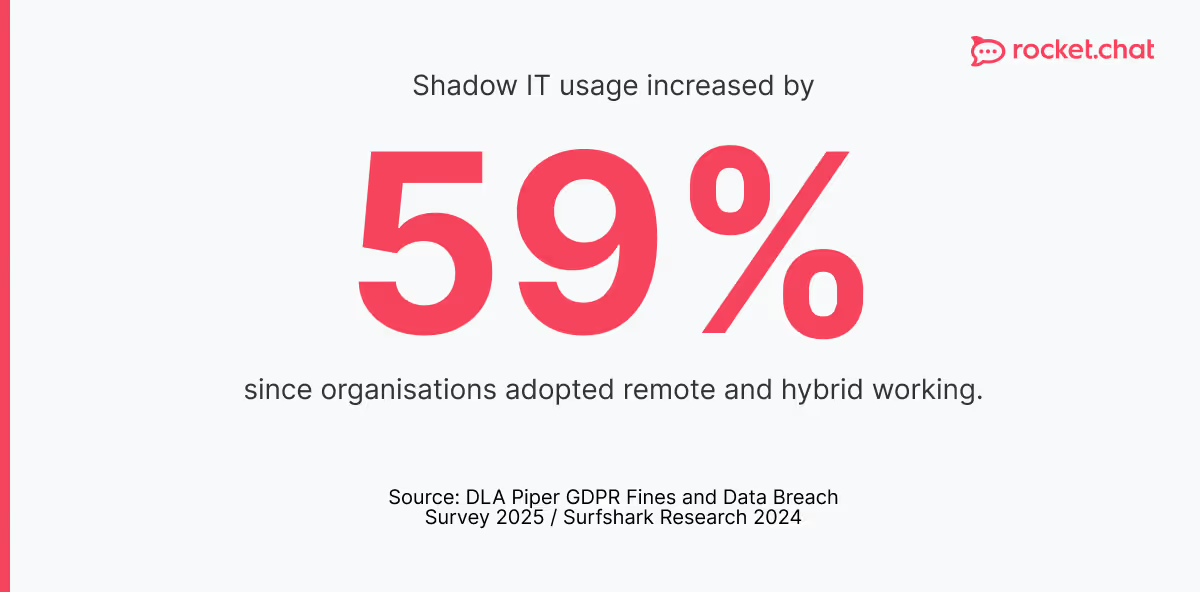
Shadow IT accounts for 30 to 40% of IT spending in large enterprises, according to Gartner research. The average enterprise runs 108 known cloud services, but an additional 975 services operate outside IT's visibility. In collaboration specifically, 67% of teams have introduced their own tools without IT approval, and 80% of SaaS adoption happens without formal review.
For organizations in defense, government, or critical infrastructure, this is not just an IT governance issue. It is a security incident waiting to happen. Consumer messaging apps lack centralized identity management, access controls, audit trails, and data retention policies. A single conversation on WhatsApp about an ongoing defense program is a compliance violation and a potential intelligence leak.
The fix is not blocking apps and hoping people comply. It is providing a secure collaboration platform through a governed chat app that meets both security requirements and user expectations. People adopt shadow IT because their approved tools are either too restrictive to be productive or too permissive to be secure. Strong organizational security requires a platform that eliminates that trade-off.
What secure internal communication actually requires
Not every platform that claims to be secure meets the standard required in regulated environments. Here is what matters, broken down by capability area.
Deployment control
The organization must be able to deploy the platform on its own infrastructure: on-premises, in a sovereign cloud, in a hybrid configuration, or fully air-gapped. If the vendor controls the infrastructure, the organization does not control its data. Self-hosted deployment is the foundation of data sovereignty.
End-to-end encryption with customer-controlled keys
Encryption protects data in transit and at rest. But if the vendor manages the keys, the encryption is a lock for which someone else holds the spare. Customer-controlled key management ensures that only the organization can decrypt its communications. This is a hard requirement for encrypted messaging in classified and regulated environments.
Granular access controls
Role-based access control (RBAC) and attribute-based access control (ABAC) allow the organization to enforce least-privilege principles. Who can access which channels, files, and integrations should be configurable by role, clearance level, project, or any organizational attribute. Combined with SSO and multi-factor authentication, this creates a Zero Trust-aligned communication layer.
Comprehensive audit logging
Every message, file transfer, permission change, and admin action must be logged and exportable. Audit trails are not just for post-incident forensics. They are required for ongoing compliance with frameworks like NIST 800-53, ISO 27001, and NIS2. Without them, the organization cannot demonstrate control during an accreditation review.
Data loss prevention and retention policies
Configurable retention policies let organizations enforce data lifecycle management. DLP capabilities prevent sensitive content from leaving controlled channels. Together, they address both the "keep what you need" and "protect what you have" sides of communication security.
Federation with governance
Cross-organization collaboration, whether between agencies, coalition partners, or departments, requires federation. But federation without governance is a liability. The platform must enforce identity verification, moderation policies, and permission boundaries across federated connections. Matrix-native federation provides interoperability without external homeserver dependencies.
How self-hosted platforms solve the sovereignty problem
Data sovereignty is the principle that data is subject to the laws and governance of the jurisdiction where it resides. For a government messaging deployment, this means communications data must remain within the government's infrastructure and legal jurisdiction.
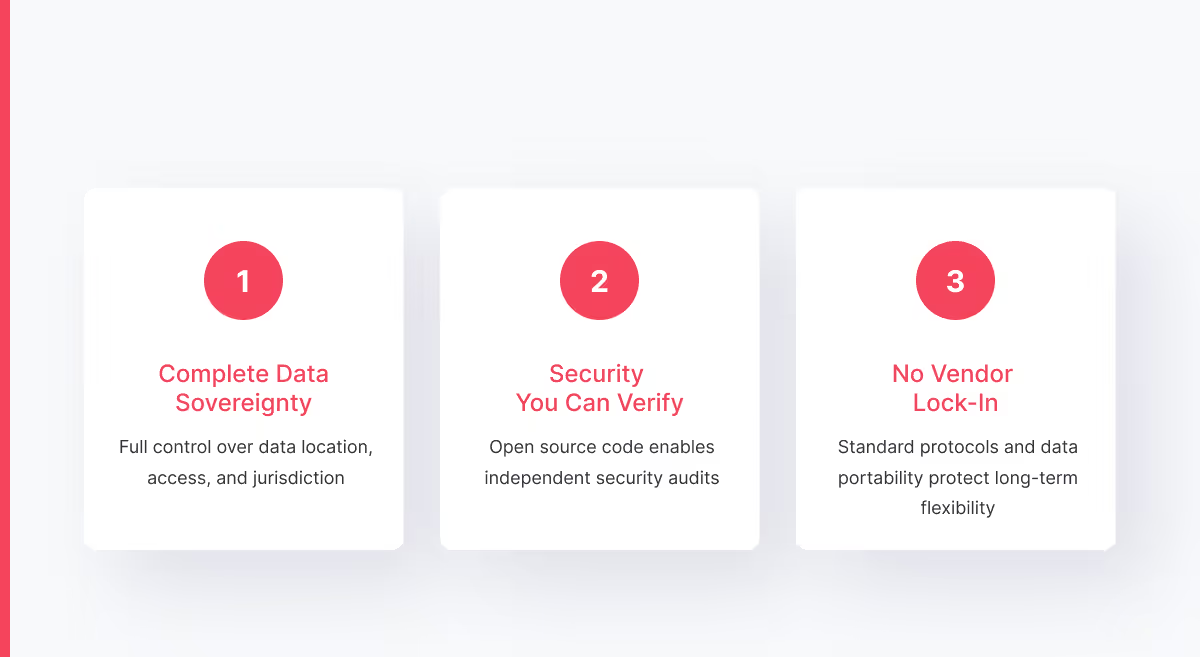
Self-hosted, open-source platforms address this at the architecture level. The organization deploys the platform on infrastructure it controls. It manages its own encryption keys. It configures retention, access, and audit policies to match its regulatory environment. No data leaves the perimeter unless the organization explicitly allows it.
This is not a theoretical advantage. The EU's NIS2 directive, GDPR's data residency provisions, and national frameworks like Germany's IT-Grundschutz and the UK's NCSC Secure by Design all assume that the organization, not a third-party vendor, is responsible for securing its communication infrastructure. A self-hosted platform makes that responsibility operationally achievable.
Open source adds a layer to secure collaboration that proprietary platforms cannot match: verifiability. When the source code is available for inspection, the organization's security team, or a national security agency, can audit it. There is no trust gap. Security posture is inspected, not assumed. For European public sector organizations, where 58% are exploring open-source alternatives for better autonomy and adaptability (Source: European Commission OSPO survey, 2023), this is a deciding factor.
Secure internal communication for specific sectors
The requirements differ by sector, even though the principles are the same.
1. Government and defense. Government communication at classified levels requires air-gapped deployment, formal accreditation (ATO up to IL6 in the U.S., ACP 240 alignment in the UK), and support for disconnected, degraded, intermittent, or limited (DDIL) conditions. The platform must function without any external connectivity. Agencies report up to 2.5x faster decisions during critical operations when communications are centralized on a self-hosted platform.
2. Critical infrastructure. Energy, transport, water, and telecoms operators need out-of-band communication channels that function when primary networks are compromised. 60% of utilities experienced at least one cyber incident disrupting operations in the past three years (Source: Ponemon Institute, 2023). The platform must provide operational resilience, not just day-to-day collaboration.
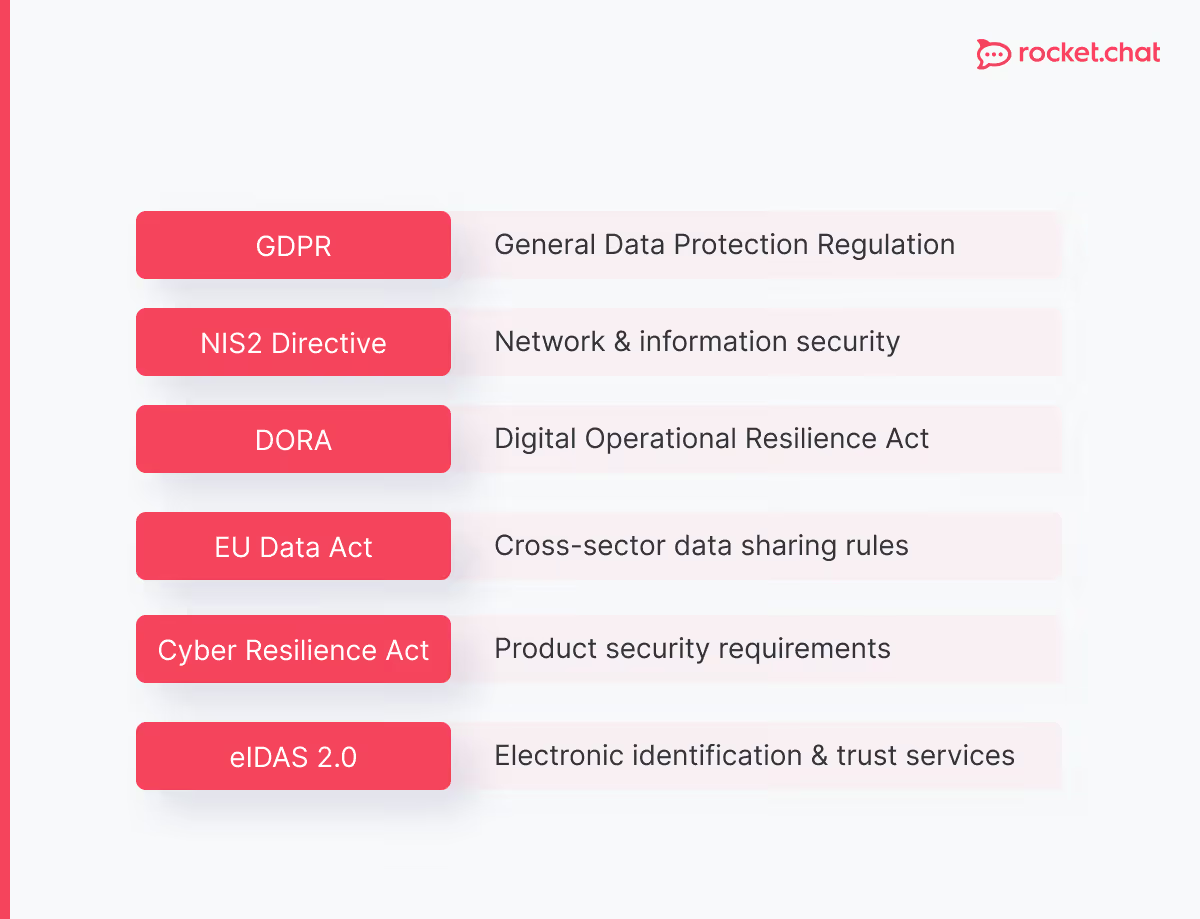
3. European public sector. GDPR-compliant messaging and NIS2 alignment are baseline requirements. EU institutions and member state agencies need sovereign deployment options, Matrix-native federation for cross-agency collaboration, and compliance with frameworks like eIDAS and EUCS. 92% of EU public sector leaders say data residency and sovereignty are top priorities in digital transformation decisions (Source: Capgemini, 2023).
4. Healthcare and financial services. HIPAA, SOC 2, and sector-specific audit requirements demand full data lifecycle control. The platform must support configurable retention, access segmentation by department or sensitivity level, and integration with existing compliance reporting systems.
Comparing secure internal communication platforms
Not all platforms marketed as "secure" offer the same level of control. Here is how the main categories differ.
Organizations evaluating secure messaging for European governments or defense operations should prioritize deployment control and encryption key ownership above all other factors. These two capabilities determine whether the organization can actually meet sovereignty and accreditation requirements, or is relying on a vendor's assurances.
Getting started with secure internal communication
Moving from consumer-grade or SaaS collaboration to a secure, self-hosted platform does not have to be disruptive. The practical path involves four steps.
1. Audit your current communication landscape. Identify every tool in use, approved or not, and map which data flows through each one. This reveals shadow IT exposure and compliance gaps.
2. Define your compliance requirements. Which frameworks apply? GDPR, NIS2, NIST 800-53, ISO 27001, national defense standards? The answer determines your deployment model, encryption requirements, and audit capabilities.
3. Evaluate platforms against operational requirements, not feature counts. Deployment flexibility, encryption key control, governed federation, and extensibility matter more than the length of a feature list. Look for platforms that support your workplace team communication needs while meeting security and compliance baselines.
4. Plan for interoperability. Most organizations will not replace every tool overnight. The platform must integrate with existing systems, from instant messaging platforms to video conferencing, identity providers, and mission-critical applications. APIs, SDKs, and a governed app framework make this possible without creating new security risks.
.avif)
Rocket.Chat is purpose-built for secure collaboration in organizations that need this level of control. As a self-hosted, open-source chat platform, it unifies messaging, voice, video, and AI-powered workflows in a single platform that deploys anywhere: on-premises, in sovereign cloud, hybrid, or fully air-gapped.
With customer-controlled encryption, granular RBAC/ABAC, comprehensive audit logging, and governed federation via Matrix protocol, it enables organizations to meet compliance and sovereignty requirements without compromising operational capability.
Deployed by EU agencies, NATO-affiliated organizations, defense contractors, and critical infrastructure operators worldwide, Rocket.Chat is built for environments where secure internal communication is not negotiable.
Note: Compliance and regulatory requirements vary by jurisdiction. Organizations should consult their own legal and compliance advisors when implementing secure internal communication strategies. Rocket.Chat enables compliance readiness but does not claim compliance on the customer's behalf. Visit the Rocket.Chat Trust Center for current certifications and security documentation.
Frequently asked questions about <anything>
secure internal communication
What is secure internal communication?
Why is secure internal communication important for government agencies?
How does NIS2 affect internal communication requirements?
What is the difference between self-hosted and SaaS communication platforms?
Can secure internal communication platforms integrate with existing tools?
How does open source improve communication security?
What industries benefit most from secure internal communication?


- Digital sovereignty
- Federation capabilities
- Scalable and white-labeled

- Highly scalable and secure
- Full patient conversation history
- HIPAA-ready

for mission-critical operations
- On-premise and air-gapped ready
- Full control over sensitive data
- Secure cross-agency collaboration
%201.svg)
- Open source code
- Highly secure and scalable
- Unmatched flexibility

- End-to-end encryption
- Cloud or on-prem deployment
- Supports compliance with HIPAA, GDPR, FINRA, and more

- Supports compliance with HIPAA, GDPR, FINRA, and more
- Highly secure and flexible
- On-prem or cloud deployment